Blog
24 August 20268 min read
What Solar’s Price Increase Means for Factory and Warehouse Owners
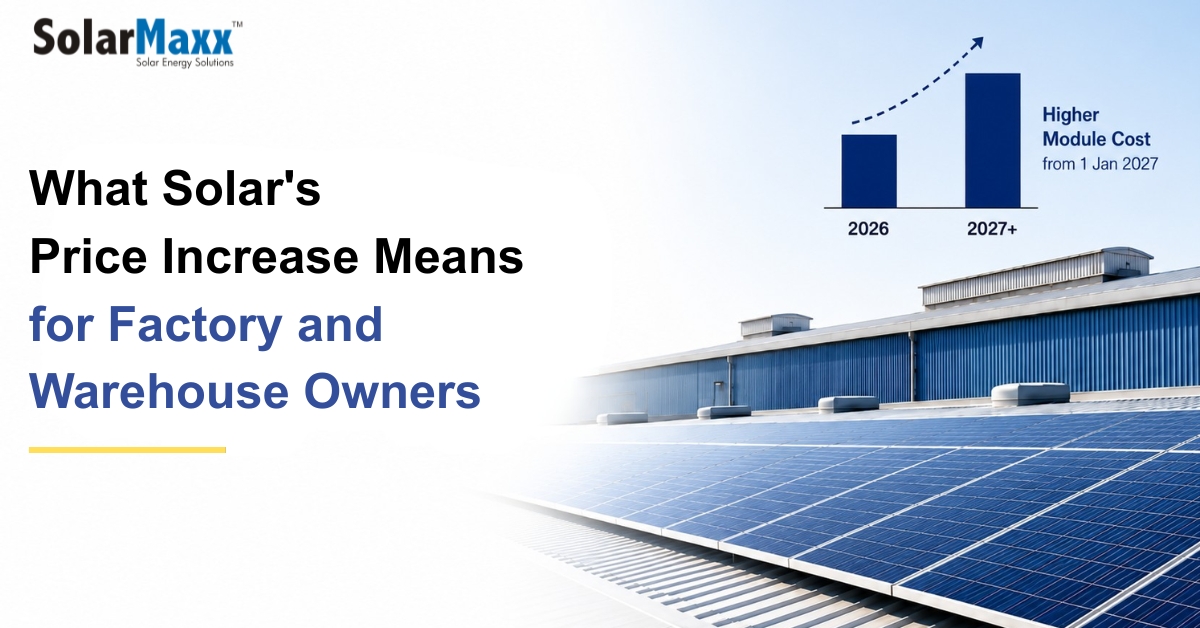
Solar module prices are expected to rise for most categories of project from January 2027. Whether yours is one of them depends on a question most buyers are never asked.
In short
- From 1 January 2027, solar projects in certain categories must use panels built with cells from approved Indian manufacturers. Approved cells are scarce, so prices are expected to rise.
- ICRA estimates modules built with domestic cells cost 3 to 4 US cents per watt more than comparable modules built with imported cells.
- A window is open until 31 December 2026 for net-metering and open access projects to use the currently approved, more reasonably priced solar panels. To use it, the plant has to be commissioned by this date.
Capital decisions are difficult when the quoted price, the equipment specification and the regulatory position can all change before a project is finished. That is the position faced by some factories and warehouses planning for solar in 2026.
What ALMM List-I and List-II actually are
ALMM stands for the Approved List of Models and Manufacturers, maintained by the Ministry of New and Renewable Energy (MNRE), the register of equipment permitted in certain kinds of solar projects.
A solar panel, or module, is several cells wired together behind glass. The cells turn sunlight into electricity.
List-I covers the finished module and has applied since 2019. List-II covers the cells inside it and took effect on 1 June 2026.
Until List-II, an Indian factory could buy cells on the world market, assemble them into a panel, and that panel counted as domestically manufactured. List-II moves the approval requirement one stage further up the chain.
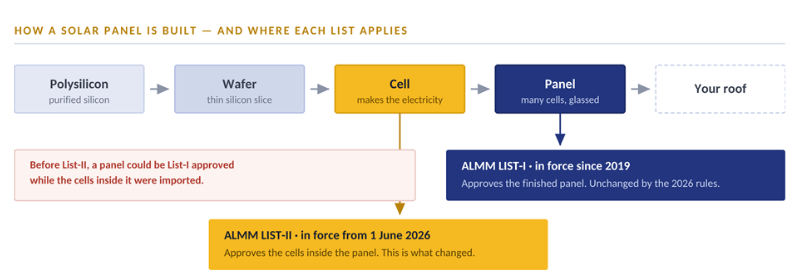
Figure 1. List-I approves the finished panel and is unchanged by the 2026 rules. List-II approves the cells inside it. Conflating the two is the most common misreading of this rule.
Listing works at the level of the model and the factory that built it, so a brand name on its own tells you very little. And ALMM only decides what is allowed, it says nothing about how well a panel performs, that is two listed panels can sit far apart on efficiency and on what their warranty actually covers.
Why List-II was introduced
Making cells takes semiconductor-grade factories and a lot of money. Turning those cells into panels is far easier, and anyone who has run a plant will know the pattern. India built the easy half first, and built it very large, while most module factories carried on importing their cells. List-II is meant to change that, by pushing demand towards Indian cell makers.
Does the deadline apply to your project?
This should be settled before anyone discusses panel prices, because it decides whether the rest matters at all. The answer depends on how the plant connects to the grid.
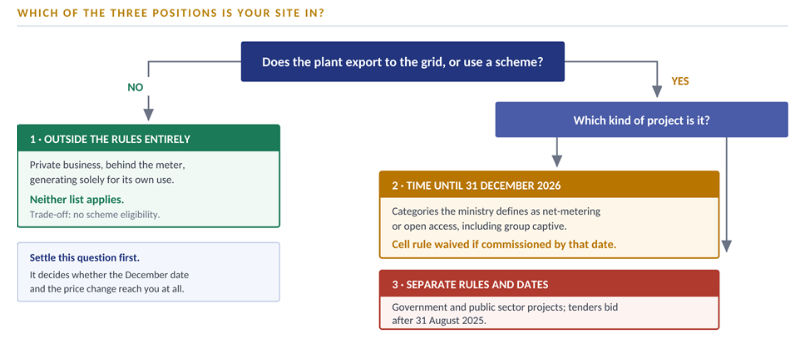
Figure 2. Position as at 19 August 2026, following the ministry’s clarification of 4 August.
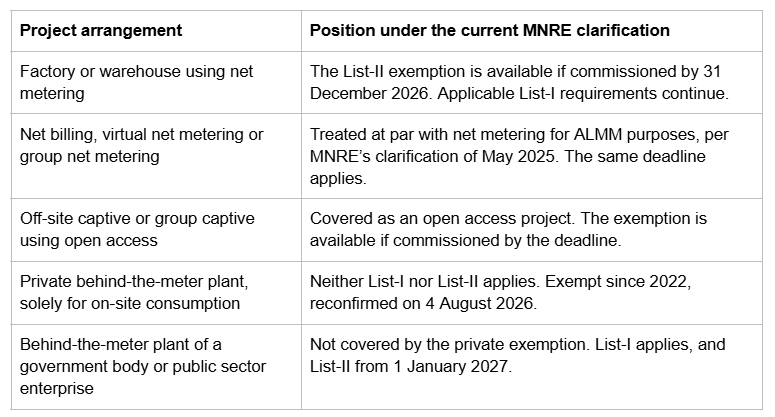
One distinction trips people up: “captive” and “behind the meter” mean different things. A behind-the-meter plant sits on your side of the meter and keeps everything it generates on site. You can still draw normal grid power alongside it. An off-site captive plant sends its power out through the grid, which makes it an open access project and sits firmly inside the rules.
Why List-II could put upward pressure on prices
There is no official ALMM premium, and no single percentage that applies to every project. The pressure comes from several connected supply-chain effects.
A smaller pool of eligible cell supply
Approved module capacity reached 217,107 MW in the ALMM List-I update of 4 August 2026. Approved cell capacity, at the eighth revision of List-II on 22 July 2026, stood at 31,758 MW across fourteen manufacturers, roughly seven times smaller.
Headline capacity also overstates what is actually available. Wood Mackenzie estimated in August 2026 that only about 16 to 18 GW of cell capacity was genuinely operating, against nominal capacity of 27 to 30 GW, because some plants were still being commissioned or running below full output.
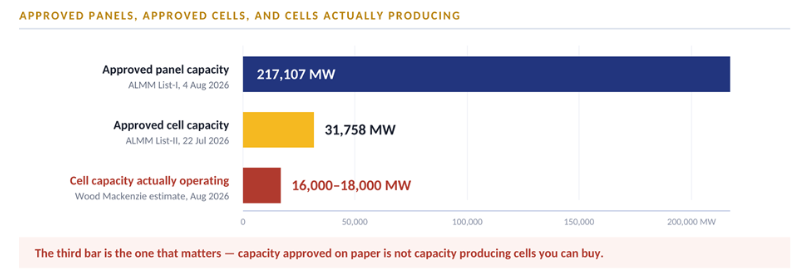
Figure 3. Approved capacity from the ALMM List-I update of 4 August 2026 and List-II 8th revision of 22 July 2026; operating estimate from Wood Mackenzie, August 2026.
Domestic cells have carried a premium
Imported cells have benefited from larger global scale and mature supply chains. The Council on Energy, Environment and Water put domestic cells at around 45 per cent more expensive than imported cells even after customs duties, as at October 2025. At module level, ICRA estimates that modules built with domestic cells cost 3 to 4 US cents per watt more than otherwise comparable modules built with imported cells.
A dearer cell only partly feeds through into the module price, and the module is only part of what you pay for. Inverters, mounting structures and installation labour carry on costing what they cost. That is why a headline like “solar will become thirty per cent more expensive” misleads.
The exemption itself creates a short-term rush
Some of the pressure arrives before 2027. Everyone chasing a December commissioning is after the same panels and the same installation crews, and queuing for the same inspections. So there are two separate risks: a squeeze before December, and a possible premium on compliant modules after it.
What the 31 December 2026 deadline actually requires
List-II took effect on 1 June 2026. Seven weeks later, the ministry issued Office Memorandum No. 283/53/2026-GRID SOLAR, dated 18 July 2026, allowing net-metering and open access projects to commission without List-II cells until the end of December 2026. The ministry was clear that this was a narrow concession. A clarification on 4 August 2026 confirmed the exemption applies automatically, with no approval to seek and nothing to register, and that List-I obligations carry on as before.
One word carries the whole condition, and most buyers guess wrong about which. The exemption applies to projects commissioned on or before 31 December, i.e. installed, tested, approved and running on the grid. A signed contract will not get you there. Neither will panels sitting on site, or a finished installation still waiting on its connection.
The path runs from a site survey and structural check through design, procurement, installation, inspection and metering, and finally the grid connection. Most of it happens in sequence; the process varies by state, and approvals here are usually counted in months.
A factory has to fit the work around production shifts and shutdown windows. A warehouse may hit roof condition or tenancy limits. And grid approvals sit well outside the installer’s control. So a credible programme starts from the commissioning date and works backwards.
For a project being scoped now, the December window is tight, and for many it has already closed. Anyone promising otherwise is promising something they do not control.
What should factory and warehouse owners do now?
Start by working out where the project stands, rather than by ordering equipment. Confirm how the plant will connect, then check whether the roof and the electricals are actually ready. If the exemption applies to you, be honest about whether commissioning by 31 December is achievable. Where the schedule looks shaky, price up a fully compliant proposal alongside it and compare the two.
On the proposal itself, a price held open for thirty days tells you nothing about whether panels have been set aside for you, or whether that price survives a delay. Seven questions will settle where you stand.
- Does ALMM apply to our exact connection arrangement? Behind-the-meter self-consumption, or a category that exports or draws on a scheme. This answer determines whether the rest applies at all.
- Which manufacturer, model and factory have been quoted? Listing works at model and factory level, so ask for the exact model number in writing.
- Do those modules use cells from a current List-II manufacturer? If the proposal leans on the exemption instead, ask them to say so plainly.
- Have the panels actually been set aside for you? Or is supply still subject to availability? Those are very different promises.
- What happens to specification and price if commissioning moves into 2027? Who carries the cost of compliant replacement modules, and on what terms. This can be allocated in the contract in advance.
- Can the supplier substitute another module, and on what conditions? Ask what technical and warranty terms apply to any substitution.
- What is the realistic commissioning date, including approvals and site constraints? Not the installation date. Ask for approval steps listed separately, with expected durations.
A proposal that cannot answer these in writing has not looked. The contract should also say who pays if the rules force a change of panel; otherwise, a delay can leave you holding a price that only ever applied to equipment the project can no longer use.
Treat the deadline as a scheduling problem. Working through these questions protects you far better than being told a price has been “locked” because a quotation was signed.
What changes for projects commissioning in 2027
Projects in the covered categories commissioning from 1 January 2027 will need panels built with cells from approved domestic manufacturers, a narrower supply pool that has to be planned around rather than assumed.
None of this is a reason to shelve a project. Approved cell capacity has grown with every revision of List-II, and the premium should narrow as more of it comes online. The real change is that module supply moves up the agenda.
Working out where your site stands
The most useful question in this article is also the hardest to answer from a distance: which position your site is in. The answer sits in your connection documents.
SolarMaxx has built 600+ rooftop sites across 12+ states since 2008, with projects across pan-India and pan-Africa. Every project begins with a pre-feasibility study, shared before you commit to anything, and metering applications and approval follow-up are handled as part of the contract. You can also check our case studies.
If you want your site’s position established before making a decision, start with a free site assessment.
Frequently Asked Questions
Does the ALMM rule apply if my factory uses all the solar itself?
Whether your own project qualifies comes down to how it is wired and metered. Contact SolarMaxx to learn more.
Is ALMM List-II the same as DCR?
No. The Domestic Content Requirement is attached to specific subsidised schemes and requires both cells and modules to be made in India. ALMM List-II is an approval list for cell manufacturers, applying to a wider set of project categories. The ministry confirmed on 4 August 2026 that Domestic Content Requirement provisions are unchanged.
Could the 31 December 2026 deadline be extended again?
It has moved before. The original date was 1 June 2026. The ministry has stated there will be no blanket extension.
Build your schedule on the assumption that the date stands. If it does move, you have lost nothing by being ready early.
Get a Site Assessment
Lock in your solar proposal before sourcing costs rise. Our team will get in touch within one business day.